
Isha Prayer Time: When It Starts & Ends
Isha prayer time starts when twilight disappears and ends before Fajr. See how it is calculated (ISNA 15 degrees), why it shifts daily, and the last valid time.
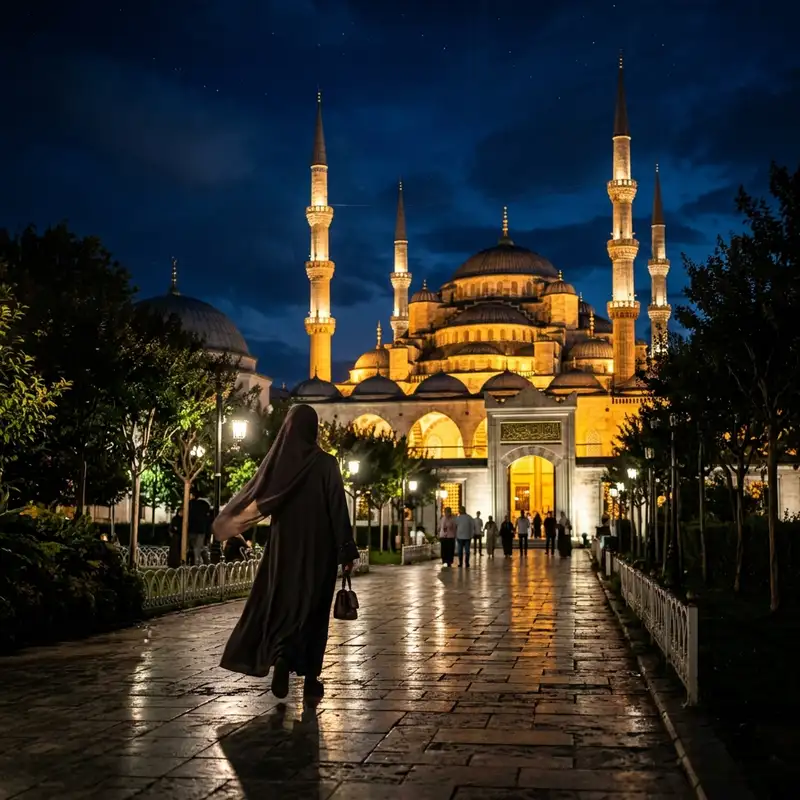
The isha prayer time is the window for the fifth and final obligatory prayer of the Islamic day. It begins when the red and white twilight left over from sunset has completely vanished from the western sky, and it runs through the night until the first light of dawn. Because this window is defined by the sun's position below the horizon, the clock time for Isha shifts every single day and swings widely between summer and winter. In South Asia, many Muslims look up the isha namaz time, the same fifth daily prayer, and the calculation method below applies whichever term you use.
How the Isha Prayer Time Is Calculated
Unlike Maghrib, which is simply sunset, Isha is defined by how far the sun has sunk below the horizon. Astronomers and jurists express this as an angle of solar depression, and the three methods you will meet are:
- ISNA (15 degrees): the standard across the United States and Canada, and the method used on every page of this site. Isha enters when the sun is 15 degrees below the horizon.
- Muslim World League (18 degrees): common in Europe, Africa, and parts of Asia. Because the sun must sink further, Isha falls a few minutes later than the ISNA time.
- Umm al-Qura / Mecca (90 minutes): instead of an angle, Isha is fixed at 90 minutes after Maghrib year-round. In summer at higher latitudes this can place Isha before true darkness, which is why American mosques do not use it. Our Mecca vs ISNA comparison walks through the difference with worked examples.
The angle method matters more than most people realize: in June, the gap between a 15-degree and an 18-degree Isha can stretch past 20 minutes in northern US cities. If your timetable and your prayer app disagree, the calculation method is almost always the reason. See why prayer times differ between apps and mosques for the full breakdown.
When Does Isha Time Start?
Isha begins at the disappearance of twilight, known in Arabic as al-shafaq. Scholars describe two phases of twilight after sunset: the red glow (shafaq ahmar) and the fainter white glow that follows it (shafaq abyad). The majority position is that Isha enters when the white twilight has also gone and the sky is plainly dark.
In practical terms, you do not need to watch the sky. Your city's timetable already encodes this: the Isha row is the moment the chosen angle (15 degrees for ISNA) is reached. In winter this can be as early as 5:30 PM in northern states; in summer it can fall after 10:00 PM.
When Does the Isha Window End?
This is where most confusion lives, because there are two different "ends" to know:
- The preferred end: the middle of the night. Islamic midnight is not 12:00 AM on your clock; it is the halfway point between Maghrib and Fajr. The Prophet (peace be upon him) said the time of Isha extends to the middle of the night (Sahih Muslim 612). Praying before this point is better and more rewarding.
- The permissible end: true dawn. After the middle of the night, Isha remains valid but delaying it is disliked (makruh) without an excuse. The window closes when Fajr enters.
So if you fell asleep and woke at 2:00 AM, your Isha is still valid. Pray it immediately and do not skip it. Our detailed guide answers whether you can pray Isha after midnight with the evidence from each school of thought.
Isha Adhan Time vs Jamaat Time
The isha prayer time printed on a timetable is when Isha enters, not when your mosque prays it. If you are wondering what time is Isha tonight, check your city's timetable, since the exact minute shifts a little every day. Most mosques delay the congregational (jamaat) prayer by 15 to 45 minutes so the community can gather, and some delay it deep into the night in Ramadan. The sunnah is actually to delay Isha somewhat: the Prophet (peace be upon him) would sometimes wait until a third of the night had passed, and said he would have made this the regular practice had it not been a hardship for his followers (Sahih al-Bukhari 657). Praying with the congregation at the mosque remains better than praying early alone at home.
Why Isha Shifts So Much Through the Year
The isha prayer time moves more across the seasons than any other prayer except Fajr, because both are anchored to twilight. Two forces drive the swing:
- Day length: in summer the sun sets late and sinks slowly, so 15 degrees of depression arrives very late. In Chicago, Isha can fall near 10:15 PM in June and near 5:45 PM in December, a swing of over four hours.
- Latitude: the further north you live, the shallower the sun's path below the horizon in summer. In far-northern places the sun may never reach 15 degrees down at all around the solstice, and scholars prescribe estimation methods for those nights.
This is also why travelers notice Isha "jumping" between cities: a 300-mile drive north in June can push Isha 20 minutes later even on the same date.
How Many Rakats in Isha?
The obligatory (fard) Isha prayer is 4 rakats. Around it, the full nightly sequence practiced by most Muslims is:
- 4 sunnah rakats before the fard (emphasized but not obligatory)
- 4 fard rakats (the obligation)
- 2 sunnah rakats after the fard
- Witr, usually 3 rakats, which closes the night prayers
Witr is the strongly emphasized prayer of the night and is prayed after Isha, any time before Fajr. If you pray Tahajjud later in the night, Witr is delayed until after it.
Frequently Asked Questions (FAQ)

Check Today's Verified Prayer Times in Your City
Access real-time Fajr, Dhuhr, Asr, Maghrib, and Isha times calibrated with GPS coordinates and ISNA standards across 189+ American cities.