
How Many Rakats in Taraweeh: 8 or 20
Taraweeh: 8 or 20 rakats? We explain both scholarly views, what most US mosques pray, and what to do if you join late, so you can pray with confidence.
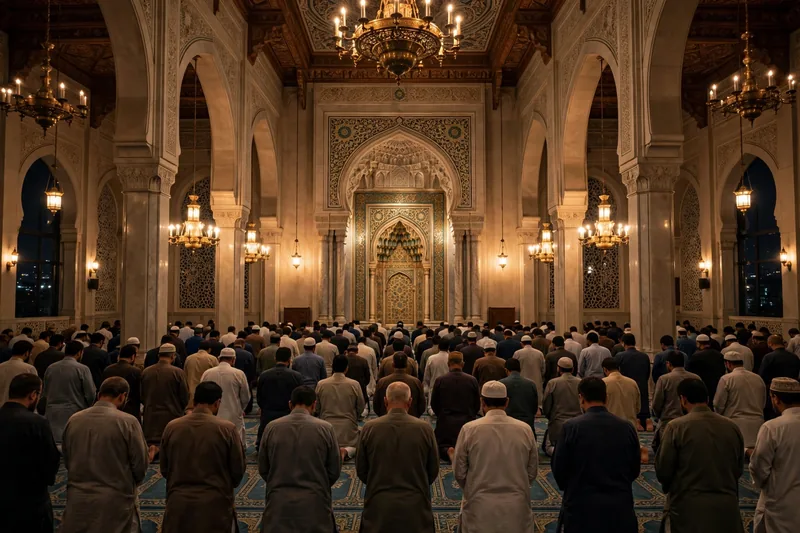
Ask a group of Muslims how many rakats in taraweeh they pray, and you may hear two different answers: 8 or 20. This debate confuses many new Muslims, and it can even make people delay going to the mosque. Here is the short answer up front: both 8 and 20 have support from respected scholars, and whichever one your local mosque prays is fine to follow. Taraweeh (the special night prayer of Ramadan) is a Sunnah prayer, which means it is strongly recommended but not obligatory. In this guide, we walk through the evidence for each number, what most US mosques actually do, and what to do if you join the prayer late.
Why Scholars Give Two Answers
The Prophet Muhammad prayed night prayer during Ramadan, but he only led it in congregation for a few nights. After his passing, the second caliph, Umar ibn al-Khattab, saw Muslims praying in small scattered groups at the mosque and gathered them behind one imam, Ubayy ibn Ka'b. From that point, taraweeh became the large congregational prayer we know today. The question scholars discuss is simply this: how many taraweeh rakats did the imam appointed by Umar lead?
Different historical reports give different numbers, and scholars weighed them differently. That is the whole origin of the 8 versus 20 discussion. No scholar in mainstream Islam has ever said the number itself is obligatory. Taraweeh is a voluntary (nafil) prayer, so the debate is about which number is better, not which one is valid. Keep this in mind, because it takes the pressure off. You cannot "fail" taraweeh by praying the other number.
The Case for 20 Rakats
The majority of classical scholars held that the established practice from the time of Umar was 20 rakats of taraweeh, followed by 3 rakats of witr. Imam al-Tirmidhi recorded that most scholars held this view, based on reports from Umar, Ali, and other companions of the Prophet. The Hanafi, Shafi'i, and Hanbali schools of thought all treat 20 as the preferred number, and the Maliki school mentions 36, which was the practice of the people of Madinah for a long period.
This majority view shapes what you see around the world. The two holy mosques in Makkah and Madinah pray 20 rakats, as do most mosques across South Asia, Turkey, and many Arab countries. In the US, many mosques with South Asian communities follow the Hanafi school and pray 20. If your mosque prays 20, know that you are following the practice of the majority of the Muslim world, and there is nothing extreme or unusual about it.
The Case for 8 Rakats
The other view goes back to the Prophet's own personal practice. Aisha, the wife of the Prophet, narrated that he never prayed more than eleven rakats in Ramadan or in any other month. This narration appears in both Sahih al-Bukhari and Sahih Muslim, the two most trusted hadith collections in Islam. Eleven rakats means 8 of taraweeh (or night prayer) plus 3 of witr. Scholars who favor 8 argue that the Prophet's own practice is the strongest possible evidence.
This view is common among scholars with a Salafi approach, and it is followed in many mosques in Saudi Arabia outside the two holy mosques, as well as in a good number of US mosques with Arab or diverse congregations. Some of these mosques pray 8 longer rakats with extended recitation, so the total time in prayer ends up similar to a 20-rakat taraweeh with shorter recitation. If your mosque prays 8, you are following a position with direct support from the Prophet's own practice, and that is a strong place to stand.
Does the Number Change Your Reward?
Reward in Islam comes from sincerity, effort, and consistency, not from hitting a magic number. A person who prays 8 rakats slowly, with focus and tears, earns more in spirit than a person who rushes through 20 while thinking about dinner. The Prophet praised quality of prayer over quantity in many narrations, and scholars across all schools agree that taraweeh prayed with presence of heart is the real goal.
That said, if you have the energy, praying more is simply more worship, and more worship brings more reward. Think of 8 as the solid minimum with the strongest direct evidence, and 20 as the fuller practice of the majority. Both earn reward. What earns no reward is skipping taraweeh entirely because you got stuck on the number debate, so decide once, then pray with a calm heart.
How Many Rakats in Taraweeh Do US Mosques Pray?
In the United States, the answer depends on the mosque's background. Mosques with South Asian communities, which form a large share of US mosques, usually pray 20 rakats following the Hanafi school. Mosques with Arab, West African, or Salafi-leaning communities often pray 8. Some diverse mosques choose one number and stick with it for unity. A few pray 8 rakats with longer recitation so the night still feels complete.
The practical step is simple: check your local mosque's Ramadan schedule or ask the imam which number they pray. Do not guess, and do not assume every mosque matches the one you grew up with. Our Ramadan 2027 hub lists prayer times and key dates for the month, so you can plan which nights you will attend. If you want the full method once you arrive, read our step-by-step guide to praying taraweeh.
What to Do If You Join the Prayer Late
It happens to everyone: you walk in and taraweeh has already started. The rule is easy. Join the congregation wherever the imam is, even if he is in the middle of a rakat. You do not need to "catch up" from the beginning. The rakats you pray with the imam count fully, and the ones you missed carry no penalty, because taraweeh is Sunnah.
If you missed the first few sets, you can pray them on your own after the imam finishes, or you can simply pray what remains with the group. Either is fine. One strong reason to stay until the end: a narration reports that whoever prays the night prayer with the imam until he finishes gets the reward of spending the whole night in prayer (narrated in Sunan at-Tirmidhi). So even on a tired night, staying to the last salam is one of the best deals in Ramadan.
What If Your Mosque Prays the "Other" Number?
Suppose you are convinced 8 is better, but your mosque prays 20. Or you grew up with 20, and your new mosque prays 8. The rule from the scholars is clear: follow your mosque. Praying with the congregation in unity is worth more than winning the number debate. If you prefer 8, you can pray 8 behind the imam and leave quietly, or stay for all 20 and take the extra reward. What you should not do is argue about it in the prayer hall or break away loudly mid-prayer. Unity in the mosque matters more than the count.
Frequently Asked Questions

Check Today's Verified Prayer Times in Your City
Access real-time Fajr, Dhuhr, Asr, Maghrib, and Isha times calibrated with GPS coordinates and ISNA standards across 189+ American cities.