
High-Latitude Prayer Times: How to Pray & Fast During Extreme Summer Days in Northern States
How Muslims in northern latitudes (Seattle, Minneapolis, Alaska) navigate 18+ hour fasts, persistent twilight, and overlapping Isha and Fajr prayer times.
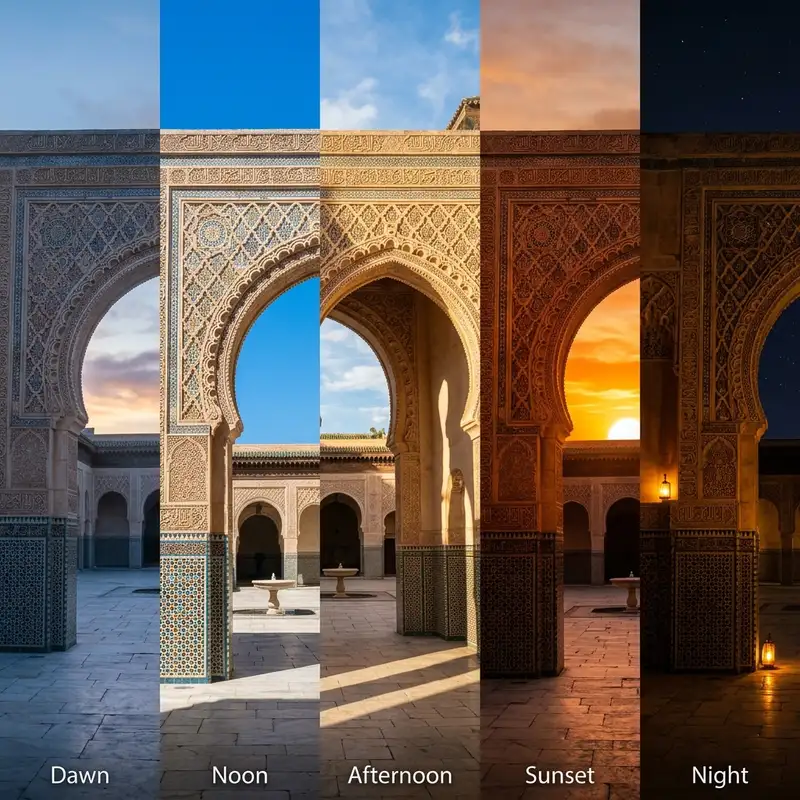
For Muslims living in northern American states—such as Washington (Seattle), Minnesota (Minneapolis), North Dakota (Fargo), and Alaska (Anchorage/Fairbanks)—summer presents unique astronomical challenges. As the summer solstice approaches in June, daylight extends to 16, 18, or even 22 hours in Alaska.
In extreme northern latitudes, the phenomenon known as persistent twilight (white nights) occurs: the sun never sinks far enough below the horizon for true astronomical darkness to arrive. This creates practical challenges: When does Isha start? When does Fajr begin? How are fasts completed?
1. The Astronomical Dilemma: When Twilight Never Ends
Under standard astronomical models, Fajr occurs at 15° (ISNA) or 18° (MWL) below the horizon before sunrise, and Isha occurs at 15° or 17° after sunset. However, at latitudes above ~48°N during summer:
- The sun reaches its lowest point (solar midnight) at only 10° or 12° below the horizon.
- Because the sun never reaches 15° or 18°, true astronomical Isha and Fajr mathematically do not exist.
- The red glow of sunset merges directly with the dawn light of sunrise.
2. Classical Fiqh Solutions for Estimating Prayer Times
Islamic jurisprudence has long addressed extreme northern regions based on the famous Hadith of the Dajjal in Sahih Muslim (2937), where the Prophet Muhammad (ﷺ) was asked about days that last a year or a month. He instructed: "Estimate for it its measure (Uqduru lahu qadrah)."
The 3 Recognized Estimation Methods (Taqdir):
- 1/7th of the Night (Al-Subu'): The night (between sunset and sunrise) is divided into 7 equal parts. Isha is set after the first 1/7th, and Fajr begins at the start of the final 1/7th.
- Middle of the Night (Nisf al-Layl): The night is split in half. Isha enters at sunset + half the night, and Fajr begins at midnight + half the night.
- Nearest Moderate Latitude (Aqrab al-Bilad): The schedule is linked to the nearest latitude where true twilight occurs (typically 45°N, near Portland or Minneapolis).
3. Combining Maghrib and Isha During Extreme Summer (Jam')
Even in cities where astronomical times exist (e.g., Seattle where Isha enters at 11:30 PM and Fajr enters at 3:15 AM), getting less than 3.5 hours of fragmented rest causes severe physical distress for working adults and students.
The Fiqh Council of North America (FCNA) and the European Council for Fatwa and Research (ECFR) have issued formal fatwas allowing Muslims in northern latitudes to combine Maghrib and Isha (Jam' Taqdim) in the mosque during midsummer, praying Isha immediately after Maghrib to safeguard community health and well-being.
4. Frequently Asked Questions (FAQ)
Prayer Times in Cities Mentioned
Check today's verified prayer times for the cities referenced in this guide:

Check Today's Verified Prayer Times in Your City
Access real-time Fajr, Dhuhr, Asr, Maghrib, and Isha times calibrated with GPS coordinates and ISNA standards across 189+ American cities.